A quantum system does not have a predetermined outcome to a given measurement, but that its outcomes emerge and are created directly as a result of the measurement process.’
V. Vedral, Musings on Quantum Mechanics
How are we to know the nature of outcomes — sense or empirical data, the stuff of the world — without critically assessing our relation to sense, detection, measurement? Perhaps I am making equivalences where there can or need not be equivalences, but the mechanism for understanding where we are situated in relation to a system, what allows us to get a “fuller picture” of what measurement is, including the function of its apparata, is a dialogue, a communication. This mechanism and its fruit are necessarily perspectival: we can only come to know the world and/via our place in it through a consistent, growing conversation between the two. This is what Paulo Freire takes to be the mechanism for the liberation of the oppressed, wherein I believe he admits a deeper epistemological truth: the emancipation of the mind — and thus a freer individual under oppression — is a constant reframing of what the world is, a constant challenge to norm, a constant state of consideration, a constant flux of idea.
Of course, we are social creatures and thus this reframing must take place amongst one another. We must learn with and alongside each other. Here enters the colloquial use of ‘communication’ — we must literally communicate with one another as intently as possible to achieve new states of awareness and, indeed, to understand that we are doing so at all. Whether there is a definite truth that can be arrived to at all is something I cannot assert. However, this dialectic, which I hence consider a defining element of scientific method, is a growth process. It will take place until we die, whether we lean into it or not. This removes the pressure to obtain any ‘objective’ truth in the first place, because all we can say with any notion of objectivity is that we ought to be as intent as possible on this journey, for the journey continues with or without our active awareness of it. The only option for us is to, without a real sense for which way is right or wrong, explore possible conceptions. Namely, possible conceptions of the self. Who we are not just in relation to the measurement device or process, but to the world. This is the task of art, not physics, but at this point there is hardly a distinction between the two. What remains of the distinction is this: the task of the physicist is to say something about what we observe, the task of the artist is to ask who are we to observe.
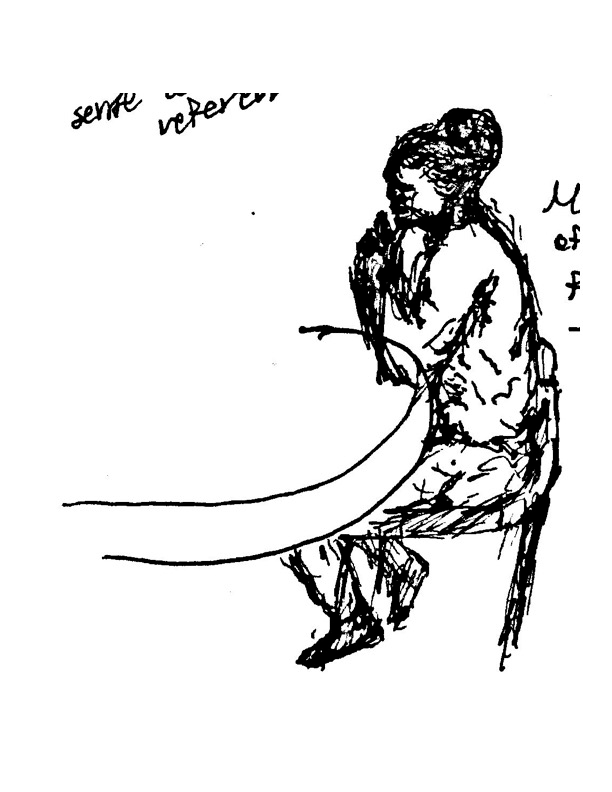
So here I turn Freire’s suggestion for pedagogy, to communicate extensively and intently with one another about our lived reality, which one knows by sense data and observation, inwards. By this I mean our new task is to communicate extensively and intently with oneself to fix a perception of one’s own lived reality. The effort should be equal and opposite the ‘outward’ effort, the effort we put into engaging with others. This communication is not restricted to spoken language: painting, dancing, poetry, any form of art offers a new form of insight into the nature of oneself. Some might say I’m overstaying a poetic license to say artistic inquiry aids, actually is needed for, physical inquiry. I think the Stern-Gerlach experiments suggest that in the end physics is all damn poetic, anyway.
As Freire says, if we are to achieve a sense of progress, in knowledge or social position (Freire’s point is that these are linked if not the same), we must take this existential poeticism very seriously. We must try to grasp or graze the ebbs and flows of our lived experience if we are to say anything about the physical world holding us at all.


 Aposiopesis
Leave a reply to Rey Cancel reply