What seems remarkable about quantum mechanics is that it successfully treats a physical system with the abstract mathematical architecture of linear algebra, situating all the information we can get about this physical system not in ‘physical’ space (x,y,z coordinates) but in a sometimes infinite-dimensional Hilbert space––the brainchild of David Hilbert. This is shocking prima facie: how does an intangible description, which has no obvious visual mechanism, correctly predict something visual? (Visual because we can observe the measurements of QM experiments like spin, which we determine by measuring distance from the horizontal on a detector, which we know because we read it off some screen or saw it directly.) It should seem as though a quantum state is a statement about existence, or yet a statement about existence being accessible to us only by some mathematical abstractions as opposed to existence accessible to us by sense organs. How can this picture of the world be physical at all? At the bottom of reality, is everything made up of statements about existence?
The obvious problem with this question is its assumption about what existence is. We cannot throw the word ‘reality’ around so carelessly. To demonstrate my point, consider the more tangible, accepted, commonsensical picture of reality that is granted to us by classical mechanics. That is, in its simplest form, the world captured by

where 


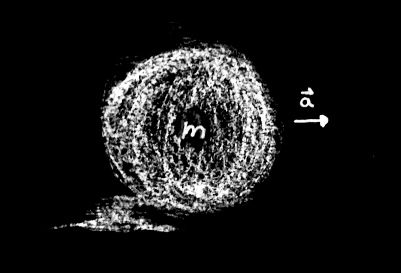
Now this seems more plausible physics than this:
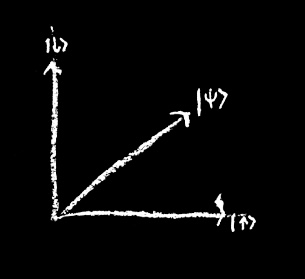
because surely we have seen a ball, have experienced the notion of its mass via its weight, and can believe a circle or sphere is a good model for it, but we have not seen a quantum state vector because it is not defined in our usual 3D space. It lives in Hilbert space, David Hilbert’s pastime. Presumably, we do not live in Hilbert space, and presumably neither does the particle 
The problem, again, is that we are naïve, of course. Naïve in our assumption that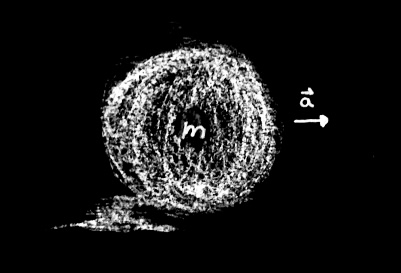 (which we treat as a point particle anyway) is any more physical than
 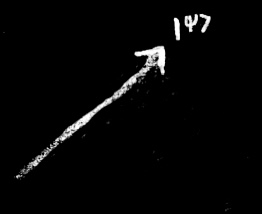 .
.
Just look at what we’ve written down. Is 
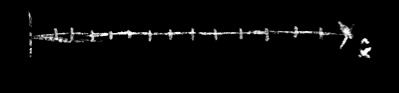
or in 3d
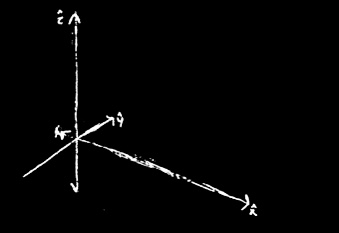
so a mass can have a trajectory,
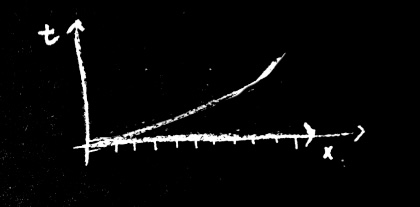

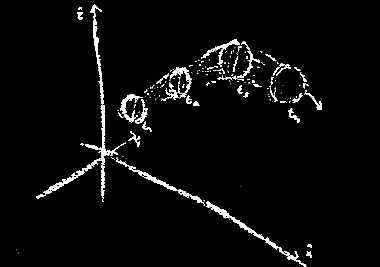
except  is about as real as
  .
.
Let me draw this further. Go to the beach. Draw a line in the sand. Tick mark it. Stand back. Look at the distance from one end of the line to the first tick mark from that end. Looks shorter than you know it is, doesn’t it? Except even if you get closer, there is another interval of that line which is shortened, and other parts which are dilated. This is without considering parallax from the curvature of your eye, ‘bending’ the picture in front of you even if the bending isn’t noticeable. For a more exaggerated version of this, look up at the horizon, look far to either side of its infinite expanse, as far as you can… the contraction is hard to miss!
The point is that our senses are fallible. What we can see is by nature perspectival. Both and are idealized abstractions. There are no distances nor balls that are perfectly lines nor spheres, which means they are not lines nor spheres. Cartesian space is as ideal as Hilbert space, and both were made up by (very talented) men with time to do so.
What is truly remarkable is that these abstractions (for their intended purposes) work. Yet they describe things in some sense less fundamental than the objects used for their abstractions (mathematical objects), because certainly it can be said that a circle to me is always a circle to you, but a distance to someone—the far end of the line in the sand to its adjacent tick mark, say—is not the same as that distance to me. Our senses are fallible and so are our metrics. What seems to remain is the abstraction itself. It should not be so concerning that the quantum state is a statement about existence in this sense, since, as a spherical mass, so is the ball, and we seem quite comfortable with that. If anything can be said to exist, maybe it should be these statements about existence. Thus the nature of abstraction itself is what we ought to concern ourselves with. (Am I a Platonist now?)

 Aposiopesis
Leave a comment